One of the worst things that can happen to a musician, besides hard drive failure or losing an instrument, is the “blank paper syndrome”. No inspiration. The will and urge to create, but, left there without any inspiration…
After finishing the album “The Xenogamous Endeavour” I was met with this syndrome for the first time. Well, I’m lying, I had periods of being uninspired before, but this time it kept on going for months! Every drumbeat, bnasslines, synthesizer melody or lyric I wrote sounded dull and unemotional for me. It had no soul, it was clear that I lost my mojo…
myself in programming at work, learned new technologies. Did a lot of walks, running and I also watched a lot of movies with my girlfriend. In essence I took a step back, I hadn’t fired up my DAW for serious work in about 6 to maybe even 7 months.
In the beginning I was very stressed, I also said that “The Xenogamous Endeavour” was the last album I ever made, and I would never be able to make another again. Gradually though, by emerging myself into the other worlds of gaming, programming, nature and movies (especially movies) made me forget about that stress - I was enjoying other parts as well.
Lightning strike
And then, suddenly, out of nowhere, me and my girlfriend decided to watch “Interstellar“. Not knowing much about the plot or the movie itself we dived right in. I was totally immersed by the cinematography, the shots, the pace, the sounds, the visuals, the acting, the story, the atmosphere.. Very little movies stay with me - I only have a few. The Professional (Léon), The Fifth Element, Moon, Ex Machina and, now ofcourse, Interstellar as well.
I couldn’t get the atmosphere the movie left behind out of my head. I was constantly reminded about certain scenes, the overall feeling and images. It inspired me so much to fire up my DAW for the first time in months. Out of that grew the first song of the album “Seven Sorrows, Seven Stars“, named “Alcubierre Drive ft. Kyoko Baertsoen” - a direct reference to the movie. I wanted to capture the overall feeling of the movie in this track I was making, both in sound design as in the lyrics.
More On Alcubierre Drive
The thriving basslines and big pads were for me the dramatic and slightly melancholic feeling I had when watching Interstallar. Alcubierre Drive’s lyrics are a description of the father / daughter relationship throughout the movie. Yet, I wanted to make sure that people could experience this without having seend the movie, so I made sure that I transposed the lyrics to the “real world”, so they can be enjoyed and understood without needing to have the full background of the movie. See this YouTube clip that combines both scenes from Interstellar, the music of “Alcubierre Drive” and the lyrics to illustrate what I mean with the fact that I’ve created my own personal “soundtrack”.
Keeping momentum
I couldn’t get enough, after that first track I started making about 10 songs which were directly related to either the feeling and atmosphere, or specific scenes. I effectively made my own personal soundtrack to Interstellar. Before I knew it I had all the demos and ideas ready, they only needed to be fleshed out - which takes a long time, but I knew I had my mojo back. I knew I could make enough songs out of this.
I never turned back to see the movie though, I wanted to keep momentum and not overanalyse the feeling I had… Going with the flow I had due to the memories that remained stuck in my head. Part of them real, part of them maybe a bit altered.
Lessons learned
Taking a step back, not thinking about music, doing other things cleared my mind. And like lightning bolt, Interstellar sparked my imagination again and delivered me a framework to work in. Out of a few exceptions all the songs on “Seven Sorrows, Seven Stars” are directly referenced to the movie, yet I always made sure to transpose the lyrics to the world we live in, or project them to my own life - so that it’s both a personal soundtrack for Interstellar as it is a reflection of how I see the world and what I experienced the past years… I picked “Alcubierre Drive” to illustrate the point, but as I said, there’s numerous other tracks on the album that directly relate to the movie - or to a specific scene.
Inspiration is a weird one. When it is there, it’s sometimes too much to handle, when it’s lost it’s almost impossible to get it back. This experience made me realise that now I can draw inspiration from everywhere - and that when it doesn’t come immediately, I shouldn’t worry or stress too much. Eventually a lighting strike will hit me again to kickstart another creative period!
What are your methods to get back your “creative mojo” or to break out of the lack of inspiration loop?
TL;DR>If you are a band, musician or business guy/girl that dreams of a future where there’s a need to have revenue from music then you should absolutely take a closer look at AudioKite. However, if in your dreams revenue is not a factor, then leave AudioKite in the back of your mind, but don’t waste time and/or money on it. And even if this service will give you good results, there’s still the real world that will have to decide. So use it wisely, or be wise and maybe just don’t use it ;)! Read more on why I believe this is true below…
What is AudioKite?
AudioKite promises to give you “Market Research for Music Creators”. In short, it says it’ll survey your music to thousands of active consumers so you can learn about the strengths and weaknesses of your music, the attention span, what genres it fits into, with what brands you can assiociate it etc.. etc.. All this is brought to you in a single page report that you scroll, hove and click on - in a very friendly and nice UI environment. You can find all of this in more detail on their website audiokite.com - they even break down what the audience (demographics) is you’re sending your music to.
Is that really true?
To be fair, I heard about this platform through Brian Hazard of Color Theory, who wrote an article about his experience with AudioKite on his blog “Passive Promotion“, which dates from 2014 ~ roughly two years before I tried it out. It sounded amazing in that article, so I gave it a shot. However, things aren’t quite as they seem. As you’ll read below, I do have some remarks and points to make to state that it isn’t a tool for everyone out there. So before you even start I’d consider you to read up about the service and decide whether it’s something you feel you need to invest in with your music, or not.
My experience With audiokite
I signed up, chose their “Commercial Potential Report” with 50 listeners three times, coming at a price of $29.99/report. I uploaded three tracks of which I felt were varied enough to give a clear view per report of the range/spectrum of the audience at AudioKite and their reports. I went for a smothh, vocal heavy, electronic triphop like song called “Never Look Back ft. Ellia Bisker”. Next I chose for “Not What I Expected ft. Fallon Nieves” which is a more upbeat dark electro track, still vocal heavy but also relying on a lot of synth elements - no conventional radio material. To close, I picked “Wild Ride ft. Miss FD“, a typical big beat industrial-electro tune. Complete with distorted vocals, energetic beats and a big focus on the musical/electronic elements. Here are the links to the songs and the accompanying reports I got from AudioKite which I will discuss in this blogpost:
“Never Look Back ft. Ellia Bikser” [ open report | stream track ]
Scoring a 7.0 on average, 96th percentile*, +0.6% from the AudiKite average.
“Not What I Expected ft. Fallon Nieves” [ open report | stream track ]
Scoring a 6.5 on average, 71st percentile*, +0.1% from the AudiKite average.
“Wild Ride ft. Miss FD” [ open report | stream track ]
Scoring a 6.2 on average, 49th percentile*, -0.2% from the AudiKite average.
If you’re seeing a trend in the scoring versus the genre and moods of the tracks, then that’s to be expected, at least for me it made a lot of sense. It’s what I predicted in terms of overall enthusiasm for one song against another - which proves to me at least that the AudioKite audience is quite predictrable - even though I tested it only once with three songs. It did match my expectations for this run.
*percentile: Generally speaking for AudioKite, the higher towards 100, the better. 96 would mean that for every 100 songs reviewed only 4 would’ve gotten a better review. This way you kind of know where you stand towards other songs uploaded on the service - which means 7.0 is a pretty high score. [ read more ].
Limited options
AudioKite score for song “Never Look Back ft. Ellia Bisker”
The first thing that I noticed when I uploaded my “electronic” music is that I couldn’t fit it into a good category. I wasn’t able to drill down further into the genres of electronic music, as they were so limited. I also feared that when I’d put in “indie” people would expect rock music, or when I’d put in jazz/blues people would expect just that and nothing electronic at all. So tracks 2 & 3 (Not What I Expected & Wild Ride) were filed under “Electronic” and I took the risk with song 1 (Never Look Back) to file it under Jazz/Blues. I felt this was a weak point and that I were to be potentially judged by the wrong audience as I could not specify any further. On the other hand I though that this shouldn’t matter as people do browse around and can’t choose what plays on the radio either.
Thick elephant skin
Before uploading and going all in, take into consideration how well you can deal with criticism. If you get demotivated, down, depressed or generally unhappy with negativity and personal opinions/taste of individuals, then I’d advise you to let someone else do it for you - so they can filter out the rough parts - or just simply don’t do it all. However, I feel this is actually a good element in the AudioKite system. These unfiltered messages are the humanity, the voice of the audience that listened to your track. Raw and unfiltered, as no one would ever tell you when you let them hear your music. It’s honest, it’s sometimes brutal, but sometimes so sweet as well. I really liked this part of AudioKite - even though it doesn’t really add substantial value, it’s a human touch that adds an extra dimension to an otherwise numeric filled statistical report…
science & surveys
When doing a proper survey, 50 people per song (which I chose) is really not enough to get a good scientific representable measurement to work with. But if you have to crank up that number to get a good scientific sample size (taking into consideration the population, margin of error and confidence levels), you’d have to invest quite a bit of money. For example, if I start with 500 people per song I would’ve ended up with $249.99/song - quite expensive for just one track when you’re an indie band… And do consider that when you want to get serious with these statistics, 500 is probably the minimum you want if you want to be taken seriously when using the report to pitch to say promotors, radio, labels, etc.. You’d have to ask yourself the question then, what do I want to use this report for, and really weigh out the pros & cons.
Contradicting comments & metrics
The audience are allowed to place comments, as raw and fun as they are, they’re also pretty contradictory a some times… For example in the track “Not What I Expected” some really like the vocals, whilst some dislike them - same for the instrumental bit. There’s some screenshots of quite contradicting reactions below, after reading those I’m sure you’ll get my point.
AudioKite reactions to the song “Not What I Expected ft. Fallon Nieves”AudioKite reactions to the song “Never Look Back ft. Ellia Bisker”
Again, as I said before in this blogpost: even though they are contradictory and quite useless in the general stats, I quite like them because they are so raw and honest. It’s a strong point of the system that they actually let people voice their opinion without filtering it. It goes to show that everything is quite relative and one person can adore the song while another one simply hates it, and others just don’t care enough to even write a comment!
Some useless metrics
It was difficult for me to decide whether “Brand Associations” and “Movie and Televion Associations” were relevant to me, or anyone else. At least in my view and for my music, it was irrelevant how “Not What I Expected” releated to brands like “Apple”, “Gucci” and “Victoria Secret”. I don’t think this report will convince companies, advertisers or tv & movie to license my music?
The “Song Classification” was a bit weird to me as well. In here they evaluate “In what physical environment the song could be played”.. The track “Not What I Expected” rated high on a college party & skateboard park, as well as in an art gallery.. At least my song’s title has relevance to the results they show me here.
The evaluation for music outlets go from “None” (red - not shown here), “Digital Streaming” (yellow), “Terrestrial Radio” (blue), “Satellite Radio” (green), “Digital Radio” (lilac). If thie pie chart resembles the chart of every other song uploaded on AudioKite it wouldn’t blow my mind completely. As everyone knows digital streaming is very popular nowadays, ofcourse it will score high. I don’t see the point of including this metric, apart from filler material. It’s irrelevant to me at least.
I did like the metric “Regardless of how this song clas classified, what genre is the most appropriate”. All three songs I uploaded were ultimately classified as “electronic” and scoring high(er) on “pop” than I expected.
AudioKite Fan Profile for the song “Now What I Expected ft. Fallon Nieves”
Fan profile
The fan profile seems like a good idea, and I generally like to see this reflected. It’s a sum of the other metrics shown to you, but broken down into a profile, for a listener that would either really like or really dislike your music.
I already knew this
Apart from that, a lot of things being asked I already knew. This might be the biggest let down for me in fact. I thought I’d learn something - and while maybe some people would say I did, I don’t have a feeling I tested enough people (see sample size / etc..) to really get a good indication.
Now this all feels quite generic and a bit predictable. I know what kind of music I make, and per track I can quite honestly predict who will like it and who won’t.
So, when tested, I already knew that I’m not producing radio-ready mixes with intros that are too long for radio play. Songs that are quite agressive and sometimes not suitable for national FM airplay. I’m also not aiming to have a “hit” song.. So maybe I chose the wrong report from AudiKite. it’s what I have them as feedback as well, I’m waiting for their answer on this - as I feel maybe I interpreted the intent of the report/measurement wrong. I could’ve learned more if I chose another report, or targetted it specifically to a genre that matched more with the audience that got to listen to it.
DO i run a business or do I make music?
In the end you have to conside whether your dream really is to make music for a living, or whether you live to make music. In the latter case, AudioKite can be fun, but is an unnecessary cost.
Conclusion
They all hate my band name. That doesn’t come as a suprise, I know this already, it’s the worst bandname .. “XYZ” would do better. But, I’m stuck with it, and it’s already out there with my other music and projects. It’s difficult to remember and pronounce, unappealing, but it’s out there, whether they like it or not. I can’t just change it now. yet every single report hammers that the band name is bad.. Without taking these things into consideration.
My end conclusion is a like my TL;DR, only a bit lengthier. If you wish to run your music like a business, then go have fun with AudioKite. Even though it’s limitation and expensivene nature VS scientific relvance, it does provide you some tools to analyse your music - and afterwards present those reports to the people you want to convince.
However, if you’re a band or musician that writes music without conventions, if you have no expactions on commercial succes and don’t expect to make a living off your music alone. Then I’d advise you to wait it out and not to check in. As the relevance and genre specific needs are not tight enough, and the expenses you have to make for a quality report (read: scientific relevant) are too high in my view. You’re also probably a bit too unconventional for national airplay and probably you don’t want to be compared to Rihanna, Selena Gomez or Lana Del Rey (not that I don’t like some of their music). Take your time and money to the studio, to the mixing and mastering, touring, instruments, .. and if then you have spare time & money, maybe look at AudioKite, if you really want to - but it’s not vital.
(PS: The website itself is very easy to navigate and work with - the reports are nicely made and shareable. The support team is highly accesible and responded to me within a working day. Quite happy with that ;))
As the title suggests, the track deals with the history of the human race. In particular our destruction of the world around us, and the repeated mistakes we make. Ranging from the very personal to the global, we all make mistakes, and yet, we rarely seem to be able to take those experiences with us to prevent future failure.
As a student I adored history lessons, due to the fascinating stories. I admit, I had very good history teachers, they knew how to tell a good story and that is essential. Yet I hate to see that history itself is looked upon as a boring subject…
With this song I tried highlighting my interest (passion is too strong of a word) in history and it’s relevance to the world we live in now, and the future world we’re building. Accompanied with the music video (watch on youtube: youtube.com/watch?v=mIgO8rMw9Wc), which portrays humanities repeated war mistakes, from the very beginning of the big bang up until the most recent conflicts…
Production
100 BPM, a monotone basslines, a vocal with long notes and layers of pads and synths to reach to an ultimate climax… I wanted to make a fairly downtempo track built layer upon layer, almost house/disco like, but with a dark edge to it ofcourse. I started out by using a bassline, very rigid and quite monotone, on which I added a chord sequence with just a pad. All this to give it that housey/disco feeling I was after. The main dark and somber pad which plays the main chord sequence can be heard on the soundcloud on the right. It comes from the Native Instruments ABSYNTH instrument, I don’t often use it, only when I’m after a really distinct kind of sound or feeling. It fit quite well with the drums and the bassline.
On top of that I layered a typical saw synth sound, again quite monotone, but sidechained, with delay and with a subtle change in melody at the end. The sidechaining is there to make it very groovey into the track, it almost fits like a lego piece for me, tightly in the rhythm. The delays are their to make it smooth and make it sound big. I used Native Instrument’s MASSIVE for this sound, which you can hear on the left of this page.
To complete it all I wanted a very typical element of house/disco, a repeated female chant in the background. That’s the humming Mari provided, “hmm, hmm, hmm”.. It really adds value and completes the emotion in the track for me. Listen to the track in full at to hear the end result.
The vocal Performance, A word by Mari Kattman
When writing a track, I usually end up recording a full demo version, “sung” by me to give the performing vocalist a hint of how the track should end up sounding. They then record at their home studio, or a studio close to them and send me back the files. Sometimes I’ll ask to record extras, and we iterate until both parties are satisfied. I love working with Mari, who performed the vocals on this track. She’s very talented and has a unique voice. Her timing and pitch is perfect, and her sense of giving the performance an emotional touch is amazing! I’ll hand the word to Mari now to give her perspective of working on this particular track.
“When I got the message from Yves that he wanted me to collaborate on another Psy’Aviah track, I was really excited. Yves always brings amazing heart to his music and words, and the tracks we have done in the past have been extremely well received. I feel lucky to be set up with Yves because I sort of get to make something amazing out of his brilliant ideas!
The catchy “uh-huhs” which carry through the song, were definitely right up my alley,
they sorta gave me a Dave Gahan, Depeche Mode sorta vibe.
~ Mari Kattman
When he sent me the draft for what he had in mind for “Lessons from the past” I really loved the groove of the song. The catchy “uh-huhs” which carry through the song, were definitely right up my alley, they sorta gave me a Dave Gahan, Depeche Mode sorta vibe. I love bluesy, sultry harmonies and I really felt that some of that could be implemented in this song.
I really enjoyed recording the vocals for this. My usual methodology is to sing a base part that will carry throughout the song and then play around with some ideas for harmonies. That dual harmony that comes in at the second part of the chorus was really fun to come up with, it really took it to the next level and gave the chorus some added dimension and depth. I really love working with harmonies and hearing them fall into place at the right moments. It really gives you goosebumps when you find the right fit and this song gave me plenty of those.
The song is about teaching our children these mistakes
so that they will not be repeated.
I agree fully and love that there is a great message here.
~ Mari Kattman
The subject matter of this song was especially moving to me. I feel like a lot of what we are doing right now is looking back on the wrongs we have done, to each other and to the world. There are a lot of us who feel that it is extremely important to never let our mistakes repeat themselves. I see a lot of people becoming more environmentally and socially conscious and it makes me feel hopeful as I feel it is really what must happen in order to make this world a better place for our children and all who follow after. This song, especially the video, depicts images that are powerful and moving, destruction, segregation and war are among them. The song is about teaching our children these mistakes so that they will not be repeated. I agree fully and love that there is a great message here.
I felt lucky to be a part of this collaboration and hope that this song has moved many people. It means so much to read the words of support and comments people leave about how much they enjoy the songs we work on. Thank you for listening!”
mixing process, a word by Mitia Wexler
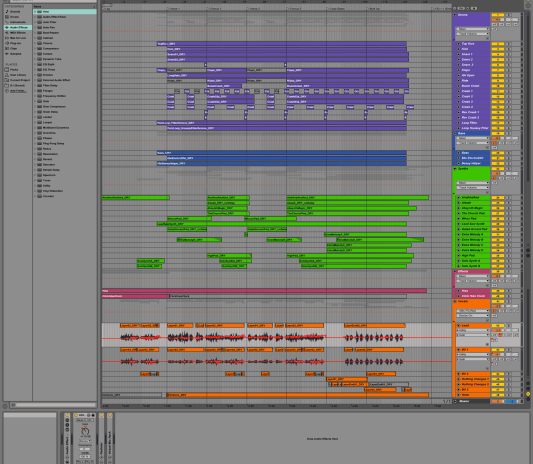
As previously mentioned in another blog post, I work with a mixing engineer to maximize the potential of the music I write. I do make my own demo mixes ofcourse, so the engineer has an idea where the track is headed, and I can go all out creatively. Yet, when sending the stems to the mixing studio, I always provide dry versions (no fx, only creative fx) so that the engineer has the “source material” to work with when mixing the track. Below you can read how Mitia Wexler tackled the song “Lessons from theh Past” in his wxlr.mx studio.
“This funky mid-tempo song is centred around its groovy beat and Mari Kattman’s vocals. As such, it was a pretty straightforward mix job — keep the low end powerful, the drums and the bass groovy, the vocals clear and present, and ornament all of that with the layers of synths.
Drums
The tracks are treated to some EQ here and there, Transient Designer for the snares — to bring out the attack, and for the second kick — to tame the muddy decay. Yves often uses musique-concrete-like crash sounds, which come with lots of low end information interfering with other elements, so these were high-passed and given some compression to prolong the sustain. The rides were also compressed to be more of a noise-pad-filler than a properly percussive element. I muted the rides and claps in the verses to further emphasise the verse–chorus contrast. The drum bus had a compressor with the timing chosen to add some punch and movement.
All in all, it was a very pleasant and a rather quick mix
that left me wanting for more once it was over.
~ Mitia Wexler
Bass
The main bass is a sampled electric bass with a very pleasant timbre, on which I used an amp sim mixed in parallel to thicken the low end and make the timbre a little more full. The synth bass called “80sElectroShit” by Mr Schelpe himself moves the rhythm along and, as its name suggests, adds an eighties vibe with a healthy dose of grit to the bass-line.
The group went into a character compressor shaving off a couple dB now and again, tightening the bass sound.
Synths
The synths did not get heavy processing, mostly minor EQ adjustments. “Absynth Magic” pad went through M/S matrix to leave some room in the centre. I mixed in a little amp sim to “Extra Melody A” lead to make its sound more abrasive. “Extra Melody D” staccato part went through a dynamic EQ to tame the “C” note that was sticking out. “Solo Synth B” lead was processed with a tube saturation emulator to make it fuller and some cabinet emulator mixed in to round off the abrasiveness handled by “Extra Melody A”.
Effects
This song has only two effect tracks, clearly heard in the intro and the outro. The “Hiss” track is present throughout, automated to get out of the choruses’ way. It is also the only track that isn’t sent to an aux track.
Vocals
Mari Kattman is an exceptional singer whose performance is both passionate and remarkably skilful and the vocals did not require much post-production trickery. I often prefer riding vocals “by hand” rather than relying on compressors. Depending on the genre, vocal style and particular delivery, the compressor route may be the best fit, but with Mari I always do it by hand, striving to retain all the live energy while keeping the vocals in harmony with the digital backdrop. The backing vocals were widened so they would fill more space in a choir-like fashion, all the while leaving the centre spot for the lead. There are some level and pan automation leaps towards the coda, where the parts switch roles.
Mari Kattman is an exceptional singer whose performance is both passionate
and remarkably skilful and the vocals did not require much post-production trickery.
~ Mitia Wexler
One of the hooks of this song is Mari’s “uh-hmm”’s. Starting with the first verse and going all the way until the coda, this is a very pleasant catchy element, but also a very repetitive one. So, aside from the level automation, the “uh-hmm”’s went through a fast attack / slow-ish release compressor with the side-chain fed by the lead vocals, giving them more movement in time with the song and leaving more space to the lead.
The vocal bus went through a compressor removing no more than one-two dB. Certain words were sent to an aux delay track.
Busses
There are two reverb auxes: one creating a light ambience to help glue everything in a common location, another one — a vast long space for the elements that are “out there” and a delay aux return.Funky and emotional, Lessons from the Past had it all — the groove, the melody, the heartfelt vocals and the polished electronic production. All in all, it was a very pleasant and a rather quick mix that left me wanting for more once it was over.”
Lyrics
(hmm, hmm)
I see the same things happening every day, every night, every time and every hour on this planet, the same thing every time I see the same things happening every day, every night, every time and every hour on this planet, the same thing every time
To all the newborns, and the young lives
All the monuments
For all the battles fought and the lives ruined
Families torn apart
We owe them lessons from the past
Recognize ignorance, lessons from the past
I see the same things happening every day, every night, every time and every hour on this planet, the same thing every time I see the same things happening every day, every night, every time and every hour on this planet, the same thing every time
To all the life living on the big blue
For all the chaos and bombs
Mistakes that were made
Habitats ruined and blood poured all just for gold
We owe them lessons from the past
Recognize ignorance, lessons from the past
I see the same things happening every day, every night, every time and every hour on this planet, the same thing every time I see the same things happening every day, every night, every time and every hour on this planet, the same thing every time
Nothing changes, nothing ever changes,
Nothing changes, nothing ever changes…
We owe them, lessons from the past
We owe them, lessons from the past…
In “Dissecting the Song” I try to explaing what’s behind the lyrics, what production techniques were used, and more…
“Words” is a track taken from the 2015 EP “Never Look Back / Words“, written by Yves Schelpe, vocals performed by jamaican artist J Aira (aka Aisha Ricketts), mixed by Mitia Wexler and mastered by Geert de Wilde.
Words, words, words…
The basic idea behind the lyrics was to portray how often words fall short to describe something. Sometimes one needs to really experience something, sometimes you need to feel it. A bit like the famous saying “a picture is worth a thousand words“. I guess you’re thinkg, duh, that’s quite obvious given the lyrics… There’s other motivations I had for writing on this topic, like the times you feel like it’s better to say nothing at all than to rattle out nonsense. The times a question’s asked and you experience a total blackout - not knowing what to say - time stands still and people wonder if you’re still on planet earth, while you yourself are just panicking and thinking, what the hell should I say? And then there’s also the moments your mind is filled with words, a lot of them, so many, but you just can’t form a sentence. It feels like you’re stumbling over them, they all want to get out in one go and this way choke you, leaving you speechless and the other people wondering, again, where the hell you are…
Production
Originally the track was more up tempo and electronic, as you can hear in an instrumental draft in the soundcloud player on this page, created for the upcoming 2016 album “Seven Sorrows, Seven Stars”. The reason it didn’t make the cut was because it didn’t fit the “tone” of the album, yet I didn’t want to let this track go to waste… So, putting it as an exclusive on the “Never Look Back / Words” EP was an ideal solution, but to make it fit I had to make a sort of triphop + motown/jazzy/retro/electro fusion remix to make it fit with the title track “Never Look Back ft. Ellia Bisker“.
Part of that was to make it more downtempo and give the drums and percussion a more acoustic feeling. (On a sidenote: I’ve always had a soft spot for acoustic drums with electronic elements fused in). Next I worked with the strings from the “Edirol Orchestral” plugin, layering a lot of parts - both filtered (as you can hear in the beginning of the track) and fully opened. To enhance a kind of triphop/retro feeling I split the bass into both a rolling bass (electronic) and a deep cello playing stackatto style most of the time, alternating with the strings that play a bit longer. (Sidenote: the stackatto style cello is from the base library of Native Instrument’s Kontakt 5 library).
Mixing process
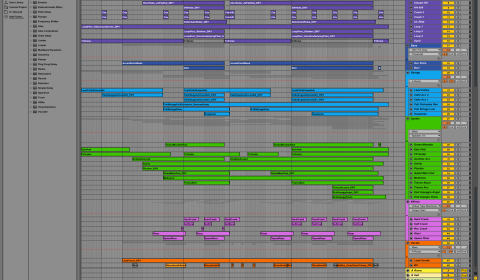
As previously mentioned in another blog post, I work with a mixing engineer to maximize the potential of the music I write. I do make my own demo mixes ofcourse, so the engineer has an idea where the track is headed, and I can go all out creatively. Yet, when sending the stems to the mixing studio, I always provide dry versions (no fx, only creative fx) so that the engineer has the “source material” to work with when mixing the track. Below you can read how Mitia Wexler tackled the song “Words” in his wxlr.mx studio.
Words Mix Session Composite in Ableton - Click to enlarge
“Words came as a B-side to Never Look Back, and as such, it naturally sought the similarly gritty modern-retro treatment.
Driven by the simple shuffling beat, the drums are punchy, in-your-face, but still tamed to keep with the laid-back downtempo feel of the song. Most of the work there was hitting that balance. The shaker loop on the left hand side in the choruses had to be quantised for its first appearance — its shuffle wasn’t going well with the groove.
Bass is the driving force and it had to be really big and imposing. Its low end is augmented by the bass amp sim blended in, with some EQ to keep it reasonable, treat an unpleasant resonant peak and further add more silky lows. The second bass voice present in the choruses went through an amp and cabinet sims with more EQ sculpting to get it out of the way of the main bass, and stereo enhancement to make its presence more enveloping and put the two basses on different planes.
The strings weren’t radically altered, mostly getting some EQ to better define each part’s space. Cellos got some light compression to prolong their sustain. Similarly, the synthesiser elements were mostly EQ’d to keep them out of each other’s way. Many were rich on low frequency components, which, while pleasant in isolation, weren’t contributing to the overall sound and were treading on bass’ toes.
The vocals, being the undisputed main attraction of the song, were a surprisingly easy job. After a few minor pitch corrections, gating the headphone bleed, and a touch of warm saturation, they just fell into place. J Airi is masterful in her delivery, so riding was minimal and a gentle compression on the vocal bus was sufficient to glue the whole thing together without flattening the natural dynamics.
There are four aux busses: a short homogenising recording space-like ambience; a long vast hall, mostly fed by strings and vocals; and two delays, used by the synths and vocals, and feeding back into the reverb busses. The mix buss is limited to a harmonic exciter adding just a little bit of high frequency spark to this song, sober yet totalling 48 tracks.” ~ this lowdown of the mixing process was written by Mitia Wexler.
Mastering process
After mixing the track went to the studio of Geert de Wilde (known of IC 434 and Skyshifter). His experience with mastering the track (and EP) is below:
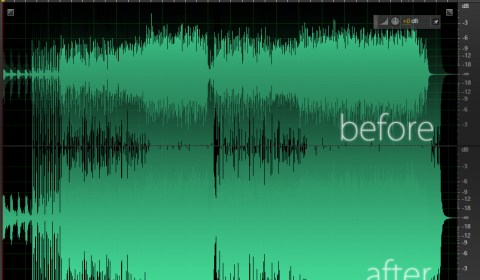
Adobe Audition View, Beofre & After mastering - Click to Enlarge
“A great composition and singing, and of course a well-balanced mixed song to start with made the job not too hard. This song although, being part of an EP that was mixed by different people with a different musical background in style, needed to fit in, keeping respect for its unique character while not standing out too much in one way or another.
The stereo balance of this song was already quite perfect and didn’t need any adjustment. A main EQ dip around 100 Hz was added because there seemed to be a lot of energy in that region in the original mix compared to the other songs in the EP. After this, I needed the subtle help of an automated EQ to get a bit more spectral balance throughout the song. This was accompanied with a long attack/very long release multibands dynamic treatment to get a more “compact” track, but in a way that this effect is almost inaudible when not paying specific attention to that aspect.
Finally, I added subtle multibands mid/side tube saturation, taking care of the main part of the “glueing together” of the different elements in the song, and also adding a bit of clearness.
Of course, all this went through my favourite wideband limiter to get rid of any unwanted peaks and to obtain the desired “commercial” loudness without losing too much punch and squashing the result - in respect to the other songs’ individual volumes.” ~ this lowdown was written by Geert de Wilde.
Video
Tight on budget, I always try to come up with a video that somehow relates with the subject matter. In the video I tried scraping together images of people staring at each other, in different situations… Awkwardly long moments, loving, scared, suspicious… - but no talking. I overlayed it with the title and added the lyrics to make a kind of “lyric video”, yet with a bit more context and visuals. All of this was done in Adobe After Effects, with the core plugin set.
no way, to let you know what I feel
to say, what I really want to say
words, where are the words?
what I really want you to know
waht I really want to say
time & time again, I rise, I fall
time & time again, I rise, I fall
these words are failing me again
these words are failing me again
these words are failing me again
I don’t know how to say
what I really want to say
what I really want to say now
what I really want to say
I don’t know how to say
mind, please give me some time
to find, no longer can I hide
why begin when I know how it ends
where should I go to find the strength
time & time again, I rise, I fall
time & time again, I rise, I fall
these words are failing me again
these words are failing me again
these words are failing me again
I don’t know how to say
what I really want to say
what I really want to say now
what I really want to say
I don’t know how to say
say, what I really want so say
words, where are the words
what I really want you to know
what I really want to say to you
these words are so damn difficult